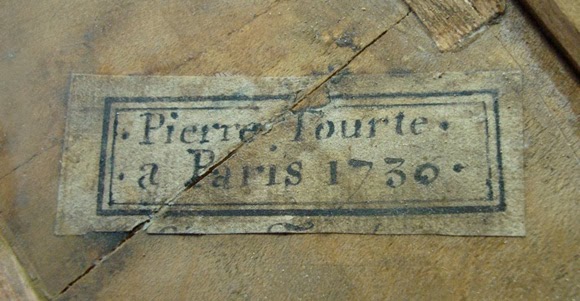
Restauration d'une vielle à roue de Nicolas Pierre Tourte dit "Tourte père".
Restoration of a Hurdy-Gurdy by Nicolas Pierre Tourte known as Tourte père.
(see below)
Little is know of the life and origins of Nicolas Pierre Tourte. Leading bow experts and makers Bernard Millant, Jean-Rançois Raffin and historian Bernard Gaudfroy have compiled what scant information is available in their authoritative work: "l'Archet français"*. The following present publication will, we hope, add to this effort, and thereby contribute to a better understanding of this important maker's work.
Pierre Tourte is registered as a "menuisier" (carpenter) in the first half of the 18th century. Working in the "Faubourg St. Antoine" neighborhood of Paris, which along with the hospice of the "Quinze Vingts" and the "cloisters of Notre Dame" constituted privileged working environments, he was exempted from the strict control of the guilds' authority.
In the 18th century, a "menuisier", thus freed from the constraints ordinarily imposed upon him by the guilds, was able to exercise his trade in the manufacture of a variety of objects. Aside from the production of furniture, he would be free to make smaller wooden objects such as boxes, cases, frames, and musical instruments and accessories. At that time the apprentices had stains less "noble" work, turning, ankles, buttons, accessories, and bows in this case, leaving for the master of the workshop the master pieces. The guilds' rules allowed workers living in these privileged places to be free to choose their techniques and materials, but however, required them to have no brands, and not put their address on the labels. Indeed, they would often perform piecework for their "guilded" colleagues who would then apply their own signature to the work thus produced. The identification of these craftsmen's instruments is, therefore, often quite difficult.
This is where the instrument that we present: a hurdy-gurdy built in the early 18th century. A pretty carved head in the style of the 17th, a flat soundbox with high ribs, at least some repairs to complete clumsy and disrupt the identification of the instrument, it is entirely covered with a thick orange paint...
more > Sinier de Ridder (in French) | in English